In short:
- It's live. Self-service Ads Manager is now marked "Available" for every European market, verified in OpenAI's official table on 1 September 2026. You can build a campaign yourself, with no agency and no OpenAI Ads Solutions team in between.
- The whole table is green. All 47 listed countries are "Available" and none is left at "Coming Soon". On 27 August 2026 it was 40 countries — 9 available and 31 "Coming Soon".
- OpenAI delivered on the promise. Its 18 August announcement said self-service would arrive "later this quarter".
- Only Free and Go plans see ads. Plus, Pro, Business, Enterprise and Edu do not — and neither do accounts identified as under 18.
- Retailers get product feed campaigns (CSV, hosted URL or SFTP). OpenAI says feed-based ads have been among the strongest performers in its programme.
- Still no euro-area minimum daily budget. The United Kingdom (£15) remains the only European entry in the table.
- Personalised ads are not initially available in the EEA or Switzerland — in Europe, ad selection leans on the context of the current conversation.
- No crawlable landing page, no ads. Pages OpenAI cannot review are not eligible to run.
Update, 1 September 2026 — it's out. This article used to end on the note that European markets sat at "Coming Soon" with no date attached. That no longer holds. In OpenAI's official Ads Manager availability table, every European country is now "Available". As recently as 27 August 2026 at 14:35 UTC — per an archived copy of the same page — all 31 European markets still read "Coming Soon", so the switch happened somewhere between 27 August and 1 September; OpenAI stamps the page itself as updated on 1 September 2026 at 03:00 UTC. The practical consequence is a single but decisive change: you no longer wait for an agency or for OpenAI's sales team. You open the account yourself at ads.openai.com and build the campaign with your own hands.
For how things stood at the announcement, see the original article ChatGPT Ads come to Europe; we left it unchanged as a record of what was verifiable then.
What exactly changed
The availability table is the only place where OpenAI states bindingly who may open an account without help. In five days it changed beyond recognition:
| 27 August 2026 | 1 September 2026 | |
|---|---|---|
| Countries in the table | 40 | 47 |
| Marked "Available" | 9 | 47 |
| Marked "Coming Soon" | 31 | 0 |
| European markets | all "Coming Soon" | all "Available" |
Alongside every European market flipping, seven new non-European markets appeared in the table: Algeria, Bahrain, India, Lebanon, Morocco, Qatar and Tunisia. The "Coming Soon" category has vanished entirely — the text below the table still explains it, but no country is left for it to describe.
Worth recalling what OpenAI promised on 18 August: ads expanding to 31 European markets, with "self-service through Ads Manager launching later this quarter". That is delivered — and somewhat earlier than expected.
What it looks like from the inside
This is no longer a table on a help page but a live Ads Manager account, a few hours after the switch:
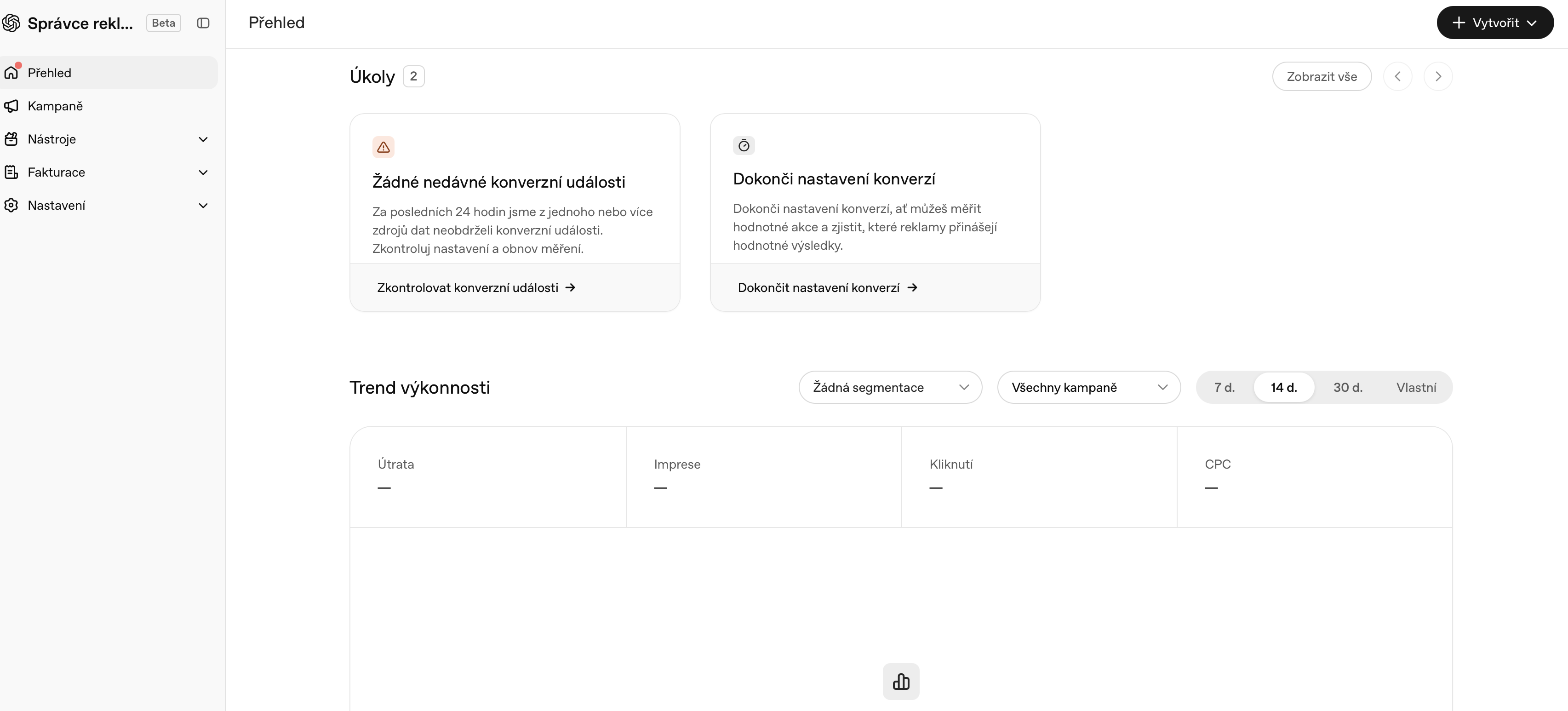
The Ads Manager (beta) overview screen, interface shown in Czech. On the left, the navigation — Overview, Campaigns, Tools, Billing, Settings. At the top, two outstanding tasks, both about conversion measurement. Below, the performance trend with spend, impressions, clicks and CPC; on a freshly created account they are still empty.
A few details you can read straight off that screen:
- OpenAI puts "Beta" right next to the product name. That is not modesty — the help centre uses "Ads Manager Beta" consistently and features are landing week by week. Expect the interface to keep shifting under your hands.
- Billing is its own top-level menu item, not a settings sub-page. That matches the rule that campaigns will not deliver until billing is complete.
- Product feeds live under "Tools". The path Tools → Feeds is exactly where you create the catalogue for feed-based campaigns — see the section below.
- Both onboarding tasks are about conversion measurement, before you have spent anything. That is a strong signal about what OpenAI is building on: without conversion measurement, oCPC is useless and your reporting is reduced to clicks.
- The metrics match what the help centre promises — spend, impressions, clicks, CPC, over 7, 14 and 30-day windows. And they are empty, because the channel is days old. That is exactly the state every European store is in right now, including the ones that will tell you otherwise.
How you get to a campaign
You sign up at ads.openai.com with an OpenAI account. The help centre describes five steps, and it is worth knowing them in advance because two of them cannot be undone.
- Create the account. Business details: name, website, logo, industry.
- Verification. Account details — country, currency, time zone — followed by a few additional questions through the Persona verification service. The account then enters a review queue; OpenAI notes that application volume is high, that it cannot expedite review, and that it emails the person who created the account. Part of that review is whether what you sell is eligible under its ad policies at all.
- Complete the account information. Under Settings → Account info, the account name and logo must be exactly as they should appear in the ad unit. Until that is done, ads will not serve.
- Billing. A billing profile (business name, address, invoice email) and a payment card.
- Invite your team under Settings → Users.
Two things you cannot change after the account exists: country, billing currency and time zone. OpenAI says so explicitly — if you get them wrong, the only route is a new account on a different email address. Decide before you click. The related rule is that your payment card should match the country and legal entity the account was created for.
What the ad form itself looks like. The headline is capped at 50 characters and the description at 100, each with a live counter. Next to the destination URL sits a separate "landing page query parameters" field supporting the template values {campaign_id}, {ad_group_id}, {ad_id}, {ad_account_id} and {oppref} — that is where your UTM tagging belongs. The wizard also enforces the hierarchy campaign → ad group → ad, so there is no "just fire off one ad".
How you pay. The model is postpay — you spend now and are charged afterwards. Each account gets a payment threshold; once unpaid spend reaches it, your card is charged. Any outstanding balance is also charged at month end even if you never hit the threshold. You cannot set the threshold yourself and support will not change it; it rises automatically with a successful payment history. When you add a card your bank may show a temporary $100 authorisation — not a charge, released after verification, though some banks display it for up to seven days.
On your own, or through an agency?
Self-service does not make agencies redundant. Next to its availability table OpenAI still states that advertisers in the new European markets can get started through the OpenAI Ads Solutions team, agency partners, or technology partners — the self-serve account is an additional route, not a replacement for the existing one.
Where platform experience actually pays off. Every one of these is documented earlier in this article:
- The account review queue. OpenAI says application volume is high, review is rolling, and it cannot expedite. Anyone already running accounts has that step behind them.
- Irreversible settings. Country, billing currency and time zone cannot be changed after creation. A misconfigured account is fixed only by creating a new one on a different email address.
- Category eligibility. Part of the review is whether what you sell is eligible at all. Finding that out after a rejection costs more than checking first.
- The OAI-AdsBot crawler. A blocking Cloudflare rule or CAPTCHA is an engineering job, not a marketing one — and it surfaces as "the ad wasn't approved".
- Feeds. Items expire after two weeks, so it needs a hosted URL or SFTP, not a manual CSV.
- Measurement. Pixel, Conversions API, and a shared event ID so conversions aren't counted twice.
How to verify an agency — and what to watch for. OpenAI runs a public partner locator where a partner can be looked up along with its tier; as of 1 September 2026 it lists 64 organisations across three tiers — Elite (10), Advanced (29) and Select (21). Whether that list is exhaustive, OpenAI does not say, so someone's absence from it proves nothing on its own. Mind above all the confusion that invites itself: this is the partner network for AI solutions, not a list of advertising agencies. OpenAI named its advertising partners separately in the announcement of 5 May 2026 — agency partners Dentsu, Omnicom, Publicis and WPP, technology partners Adobe, Criteo, Kargo, Pacvue and StackAdapt. So when someone tells you they are an "OpenAI partner", it is worth asking which programme they mean; these are two different things.
A worked example. Our own agency, MirandaMedia Group, s.r.o., is named an OpenAI Select Partner within the OpenAI Partner Network, and works with ChatGPT Ads. The author of this article is a co-founder, and we would rather say so up front. But let us be exact about what that title is and is not: the Partner Network is a programme for AI solutions — building, selling and deploying them — not a certification for buying advertising. OpenAI keeps the two separate, and so do we here. If you are looking for someone to build and tune the campaign, we are one option. If you would rather build it yourself, everything above is written so that you can, without us.
And one thing no agency changes: who sees the ad is decided by OpenAI's ads system, not by a partner. OpenAI states it plainly — partners help with budgeting, bidding and creative, while OpenAI controls all delivery decisions. Nor can anyone outside work out whether the channel pays for you; that stays a question about your own margin.
Who actually sees the ads
Keep this number close when you plan a budget: according to OpenAI's help centre, ads may appear only to users on the Free and Go plans. Plus, Pro, Business, Enterprise and Edu accounts do not have ads and will not get them.
Further limits OpenAI states:
- Ads are not shown to accounts identified as belonging to people under 18, based on account-level age information and age prediction where available.
- Temporary Chats show no ads.
- During the test, ads do not appear in the ChatGPT Atlas browser.
- A user on the Free plan can switch to an ads-free experience in exchange for lower message limits and reduced feature access.
- Ads are not eligible to appear near sensitive or regulated topics, including personal health, mental health and politics.
And one sentence OpenAI repeats in every document: ads do not influence ChatGPT's answers. The ads system runs separately from the chat model, and advertisers have no ability to shape, rank or alter responses. Ads appear below the end of a response, clearly labelled as sponsored and visually separated.
One more line matters for European advertisers: personalised ads are not initially available in the European Economic Area or Switzerland. In practice that means ad selection in Europe leans mainly on the context of the current conversation rather than chat history and memory. That cuts both ways — less targeting signal, but also far less to explain in a privacy review.
Three ways to buy, one auction
The format is simple and well documented. Every ad contains the advertiser name, a favicon, a title, body copy, a landing page and an image.
| CPM | CPC | oCPC | |
|---|---|---|---|
| What you pay for | 1,000 impressions | a valid click | a valid click |
| What is optimised | reach and exposure | clicks | your chosen conversion event |
| When it makes sense | maximum visibility | driving people to the site | pushing them to purchase |
Winners are picked by a relevance-weighted second-price auction. You set a maximum bid at ad group level; for click campaigns OpenAI recommends starting at $3–$5 per click, and Ads Manager shows bid-strength guidance on whether your bid is likely to be competitive. For conversion campaigns (oCPC) the bid is conversion-oriented — the system derives a per-click auction bid from it — but you are still billed per click, not per conversion.
A daily budget is not a daily cap; it is a seven-day average. This is the most common source of invoice surprise, and OpenAI documents it precisely: on any individual day spend may reach twice your chosen daily budget, but across the applicable seven-day period it will not exceed seven times it. Underspent days can be made up later within the same period.
Other operational details worth knowing before you build your first campaign:
- You cannot change a campaign objective after creation. Nor the conversion event on an oCPC campaign. Different goal? New campaign.
- A campaign-total budget is the stricter control on total spend — useful when you must not exceed a fixed amount.
- You cannot change the budget type after creation. The amount, yes; the type, no.
- You can target by platform: iOS app, Android app, or web (desktop and mobile web).
- You can also target below country level — regions, cities or postal codes where supported. Availability varies by country and is confirmed in the location picker during campaign setup.
- Campaigns can now include or exclude custom audiences.
Minimum daily budgets vary by the billing currency of the ad account. OpenAI has published values for ten countries: Australia 25 AUD, Brazil 40 BRL, Canada 25 CAD, India 725 INR, Japan 2,500 JPY, Mexico 150 MXN, New Zealand 25 NZD, South Korea 25,000 KRW, the United Kingdom 15 GBP and the United States 25 USD. No euro-area figure had been published as of 1 September 2026 — there is no point guessing one; you will see it during campaign setup.
New for retailers: campaigns built from a product feed
From a retailer's point of view this is the biggest change since the August announcement, and it was not in the earlier version of this article.
Ads Manager supports campaigns built on a product feed. You upload a catalogue and the system builds ads from it — product image, title, stars, price and sale price. OpenAI attaches a sentence worth reading carefully: ads created from product feeds have been among the strongest-performing ads in its programme to date.
How the feed gets in. Under Tools → Feeds you create a feed and import it one of three ways:
| Method | Best for |
|---|---|
| CSV or TXT | a first attempt, occasional manual updates |
| Hosted URL | your catalogue sits at a stable HTTPS address |
| SFTP | automated server-to-server uploads |
⚠️ Feed items expire after two weeks. Manual CSV upload is therefore a dead end — a fortnight later the campaign goes quiet. Only a hosted URL or SFTP is realistic.
A few things that are not obvious at first glance:
- Products from a feed are eligible for ads only during the beta. They do not appear in ordinary ChatGPT conversations; OpenAI says it "may offer that capability in the future".
- The ad template can currently only pick the image field. The rest of the ad is generated from feed data, so the quality of your catalogue titles and descriptions is literally the quality of your ads.
- Ad groups are assembled with filters over the feed. When the built-in filters aren't enough, you can add an
ads_metadatafield to the feed with your own values (saybidding_tierorproduct_line) and filter on those. - The Products tab is a report, not a list of uploaded products. A product appears there only once a running campaign has delivered data for it — allow up to seven hours. An empty tab does not mean the feed failed. To see how many products actually passed your filters, check the product count during ad group setup.
Context hints are not keywords
This is where ChatGPT Ads differ most from keyword-based systems.
At ad group level you supply context hints — a description of the conversations, topics or terms where your product may be relevant. OpenAI states plainly that these are not exact-match keywords and do not guarantee delivery in specific conversations. The system combines them with the context and intent of the current conversation, the landing page, the title and the copy.
That leads to advice OpenAI gives directly, and it matters for retail: build for coverage, not one perfect message. More title and copy variations per offering give the system more chances to find a conversation where you fit. And each variation should introduce a different angle, not restate the same one.
The same logic applies to destinations: link to the most relevant page — a product page or a collection, not the homepage by default.
What you may and may not advertise
OpenAI's ad policies are deliberately narrow in this early phase. The current version is v1.5, updated 31 August 2026 — the day before the availability table flipped. Allowed categories are mainly:
- household and consumer goods,
- local services,
- travel and experiences,
- digital products and education.
"All other categories are disallowed at launch," OpenAI writes. The points most likely to affect a retailer:
- Alcohol and tobacco — disallowed, including beverages above 0.5% ABV, cigarettes, vaping and nicotine products.
- Dietary supplements — those widely sold through major retailers may be permitted if they make no health claims. Diet pills, detox programmes and supplements marketed with unsupported health claims are not.
- Health products and services outside the US — generally prohibited. General wellness and fitness goods without medical claims may be permitted.
- Financial services outside the US — generally prohibited. Tools that do not themselves offer a financial product (budgeting apps, courses) generally are permitted.
- Legal services outside the US — prohibited. Version 1.5 newly permits them in the US where the advertiser is licensed in the jurisdiction the ad is shown; outside the US nothing changes.
- Gambling — disallowed, except lodging and entertainment where gambling is not the focus.
- CBD — non-intoxicating hemp-derived products with no THC may be permitted; THC products are not.
- Lingerie, underwear and swimwear — allowed in a standard fashion or retail context, not when framed to provoke sexual arousal.
- Counterfeits, individual job or property listings, political content — disallowed.
Review covers all elements together — copy, image and landing page. OpenAI explicitly states that an approved creative may not link to a destination that introduces disallowed content; its own example is a food delivery ad linking to alcohol delivery.
Most reviews run through automated systems — OpenAI says it uses LLMs and classifiers with human oversight, and adds advertiser verification and manual review in sensitive categories. And the line that matters most operationally: ads and landing pages that cannot be reviewed by its systems are not eligible to run.
The technical condition most people forget
This is the part marketing summaries skip, and it is decided by engineering, not marketing. Now that you can open the account yourself, it is the first thing you will trip over.
OpenAI uses a crawler called OAI-AdsBot to validate that the landing page complies with its policies — and it also uses page content to decide when the ad is relevant. Without a crawlable page, the ad is not approved.
The advertiser guidance names four layers that typically break it:
- robots.txt — the crawler respects the rules; if a path is disallowed, crawling stops immediately. OpenAI's own example:
User-agent: OAI-SearchBot
Allow: /

User-agent: OAI-AdsBot
Allow: /
- Web protection and bot mitigation — Cloudflare, Akamai and similar services return 403 to legitimate crawlers. OpenAI notes that OAI-AdsBot is officially verified and allowlisted by Cloudflare.
- Human verification — CAPTCHAs, JavaScript challenges, behavioural analysis. An automated system will not pass them.
- Rate limiting — bulk ad uploads can trigger throttling; look for 429 responses. OpenAI suggests uploading in smaller batches.
If your infrastructure requires a stable list of IP ranges, OpenAI publishes openai.com/searchbot.json and openai.com/adsbot.json — though it recommends relying on user-agent identification and provider verification programmes instead.
One more practical note from the guidance: the destination should be a directly reachable web page. App-store links, deep links, documents or destinations requiring an app, a login or region-specific access may not provide enough crawlable content for review. And do not count on a manual bypass — once the site is fixed, you simply re-upload the ads.
Measurement: what you get and what you don't
Ads Manager reporting currently includes impressions, clicks, spend, click-through rate, average CPC, average CPM and conversions.
Conversions are measured two ways, and they combine: a browser measurement pixel and a server-side Conversions API. The pixel supports standard events any retailer will recognise — among them page_viewed, contents_viewed, items_added, checkout_started and order_created, plus lead_created, registration_completed, subscription_created and trial_started. If you send the same conversion through both paths, reuse the same event ID so OpenAI deduplicates it. You can now also connect third-party measurement partners, mobile ones included.
You can also add your own UTM parameters to destination URLs — Ads Manager gives them a dedicated "landing page query parameters" field. They persist on ad clicks, so traffic from ChatGPT Ads shows up in your own analytics. For the first months of a new channel that is the cheapest way to form an independent view.
What you cannot get is the conversation. Advertisers do not see chats, chat history, memories or personal details — only aggregated, non-identifying performance reporting.
What we still don't know
To be straight about it — launching does not mean everything is clear. OpenAI had not published the following as of 1 September 2026, and nobody can know them yet:
- The minimum daily budget in euros. Ten countries are listed and the UK is the only European one. You will see it during campaign setup.
- How long account approval takes. OpenAI says only that volume is high, the queue is rolling, and it cannot expedite.
- How many people in any given European market will see ads. It is the Free and Go plans, but OpenAI does not publish how many that is per country.
- What a click actually costs in a non-English market. The $3–$5 recommendation is global, not local. Real numbers will come from real traffic.
- Whether it pays for your store. That cannot be established any way other than measuring it against your own margin.
Anyone answering those questions with a specific number today made it up.
Editor's take — Michal Baloun, co-founder
I expected "later this quarter" to mean the end of September. It came a month early and without an announcement — the table simply flipped one morning. That says something in itself about the pace this channel is being built at, and about why waiting for a big press release is a poor strategy.
More interesting than the launch is still one sentence in OpenAI's help centre: page content is used to decide when the ad is relevant. That is a different world from keywords. You don't declare what you want to attach to — you describe a situation, and the system matches your page to it. A product page with two sentences of description and a spec table won't get a shot even after you pay. For feed campaigns that goes double: the ad is generated straight from your catalogue titles and descriptions, so a neglected feed writes your ad copy for you.
Second thing we see repeatedly in stores, and it bites fast here: a landing page blocked by bot protection. Plenty of shops run Cloudflare rules nobody in marketing knows about, because they only affect automated traffic. Search engines don't care. Here it is a condition of approval — and the failure surfaces as "the ad wasn't approved", not as "the firewall is blocking a crawler".
Third: let's not repeat the early performance-marketing mistake of judging a new channel by return on ad spend just because nothing else was at hand. A channel that catches people mid-decision brings different orders than remarketing — a different average order value, a different return rate, a different product mix. Whether it pays off shows up in margin after cost of goods, shipping and returns. Not in revenue. And now that nobody is waiting on an agency, that mistake is much easier to make quickly and at scale.
How to work out whether it pays
Before you send the first unit of currency, you need one number: the return on ad spend at which you break even. The formula is one division — 100 divided by your net margin in percent.
A worked example (illustrative numbers, not measured): a store with a 20% net margin breaks even at a return of 5.0. At 30% margin, 3.3 is enough. The gap between those two stores is enormous, and both can show identical revenue.
A sensible sequence for a new channel with no history:
- Work out your net margin over the last 90 days — revenue minus cost of goods, shipping, marketing and operating costs.
- Derive your break-even point and a healthy level above it (a 20% buffer is a common rule of thumb).
- Tag destination URLs with UTM parameters so you have measurement independent of platform reporting.
- Record the spend as a cost in your profitability view — otherwise the new channel inflates revenue and margin mysteriously drops.
- Evaluate per product, not in aggregate. A channel aimed at the decision stage often pulls a different mix than you expect.
Here's what advice from Margly looks like
Margly does not have a ChatGPT Ads integration yet — you enter the spend manually in the Costs module, the same as for any platform without a connector. What Margly can do before you spend anything:
- A break-even point from your data, not an estimate. Margly computes break-even return on ad spend from net margin after cost of goods, logistics, marketing and operating costs — not from gross margin, which systematically understates the bar.
- Per-product profitability. Before you decide which products go into a new channel, it helps to know which ones carry margin and which only carry revenue.
- All costs in one calculation. Manually entered spend feeds the same net margin calculation as connected channels, so a new channel doesn't distort the overall picture.
None of those numbers is an estimate — they all come from your own orders, cost prices and costs.
What to do this week
This is no longer open-ended preparation. The order is deliberate, so you don't stall on the step that takes days:
- Open an account at ads.openai.com and submit it for review. The queue is rolling and you cannot speed it up, so it goes first — you can do everything else while you wait. Settle your country, currency and time zone beforehand; they cannot be changed later.
- Check robots.txt. Allow
OAI-AdsBotandOAI-SearchBot. It takes five minutes and it is a hard requirement. - Verify your landing pages answer an automated client. Fetch one of your own product pages without a browser. A 403 or a CAPTCHA means you have a problem before you start.
- Read the ad policies against your catalogue. Alcohol, supplements with health claims, THC or financial services mean this channel isn't for you yet — and finding out now is cheaper than after your account is rejected.
- Get your product feed onto a stable HTTPS address. A manual CSV expires after two weeks; a hosted URL or SFTP does not.
- Know your break-even point. When approval lands, that's one decision already made.
The honest summary of everything else: what ChatGPT Ads will actually deliver for European retailers is still not known — the first real data is days old. The only difference from last week is that you can now measure it yourself.
Frequently asked questions
Is ChatGPT Ads self-service available in Europe?
Yes. Every European country in OpenAI's official Ads Manager availability table is now marked "Available" — verified 1 September 2026. That means you can open an account yourself at ads.openai.com, without the OpenAI Ads Solutions team and without a partner agency.
As recently as 27 August 2026 all 31 European markets were still "Coming Soon", so the switch happened between 27 August and 1 September. All 47 countries listed in the table are now "Available" and none is left at "Coming Soon".
Does every ChatGPT user see ads?
No. According to OpenAI's help centre, ads may appear for users on the Free and Go plans. Plus, Pro, Business, Enterprise and Edu accounts do not have ads.
OpenAI also does not show ads to accounts identified as belonging to people under 18. Ads do not appear in Temporary Chats and, during the test, not in the ChatGPT Atlas browser either. A user on the Free plan can also switch to an ads-free experience in exchange for lower message limits.
How do I open an Ads Manager account?
You sign up at ads.openai.com using an OpenAI account. You enter your business details (name, website, logo, industry) and account details (country, currency, time zone), then complete verification through Persona. The account goes into a review queue and OpenAI emails you when access is ready; part of that review is whether what you sell is eligible under its ad policies.
Before campaigns can run you also have to set the account name and logo exactly as they should appear in the ad unit, and complete billing. Country, billing currency and time zone cannot be changed after the account is created — if you get them wrong, the only route is a new account on a different email address.
Is it worth going through an agency now that Ads Manager is self-service?
Both routes run side by side. Next to its availability table OpenAI still states that advertisers in the new European markets can start through the OpenAI Ads Solutions team, agency partners or technology partners — self-service is an additional option, not a replacement.
Experience pays off mainly where a mistake is irreversible or expensive: an account's country, currency and time zone cannot be changed after creation, review covers whether your catalogue is eligible at all, and without a crawlable page for OAI-AdsBot the ad is not approved.
Mind one confusion: OpenAI's public partner locator (64 organisations across Elite, Advanced and Select tiers) is the partner network for AI solutions, not a list of advertising agencies — those OpenAI named separately in its announcement of 5 May 2026. When someone says "OpenAI partner", ask which programme they mean.
How much do ChatGPT Ads cost?
You can buy on a cost per thousand impressions (CPM), cost per click (CPC) or conversion-optimised cost per click (oCPC) basis. Winners are chosen by a relevance-weighted second-price auction. For click campaigns OpenAI recommends starting with a maximum bid of $3–$5 per click.
Minimum daily budgets vary by the billing currency of the ad account; OpenAI has published values for ten countries, and the United Kingdom (£15) is the only European one. No euro-area figure had been published as of 1 September 2026. Note also that a daily budget is a seven-day average: on any single day spend may reach twice the amount, though never more than seven times it across seven days.
Can I upload a product feed to ChatGPT Ads?
Yes. Ads Manager supports product feed campaigns — upload your catalogue as CSV or TXT, from a hosted HTTPS URL, or automatically over SFTP. Ads are then generated straight from feed data: image, title, stars, price and sale price.
Feed items expire after two weeks, so manual CSV upload is a dead end — a hosted URL or SFTP is the realistic option. During the beta, products from a feed are eligible for ads only and do not appear in ordinary ChatGPT conversations. OpenAI says feed-based ads have been among the strongest performers in its programme.
What can't be advertised in ChatGPT?
During the early phase the allowed categories are mainly household and consumer goods, local services, travel and experiences, and digital products and education.
Disallowed categories include alcohol above 0.5% ABV and tobacco, gambling, adult content, recreational drugs including THC, counterfeits, political content, and ads for individual job or property listings. Under policies v1.5 (updated 31 August 2026), financial, health and legal services outside the US remain generally prohibited, and dietary supplements are only permitted without unsupported health claims.
What has to work on my website before I can advertise?
The landing page must be reachable by the OAI-AdsBot crawler, which OpenAI uses to check that the ad and the page comply with its policies — and whose content it also uses to decide when the ad is relevant.
You have to allow it in robots.txt, and it must not be blocked by your firewall, CDN, bot mitigation, CAPTCHA or rate limiting. OpenAI also recommends allowing OAI-SearchBot. Pages that cannot be reviewed are not eligible to run, and the guidance warns explicitly against relying on a manual bypass.
Do ads influence ChatGPT's answers?
No. OpenAI states that ads run on systems separate from the chat model and that advertisers have no ability to shape, rank or alter responses.
Ads appear below the end of a response, clearly labelled as sponsored and visually separated. OpenAI also stresses that seeing an ad does not mean it endorses or recommends the advertiser.
How do I know what ChatGPT Ads brought me?
Ads Manager reporting includes impressions, clicks, spend, click-through rate, average CPC and CPM, and conversions. Conversions are measured with the browser pixel, the server-side Conversions API, a connected measurement partner, or a combination — when you combine them, reuse the same event ID so a conversion isn't counted twice.
Independently of that, add your own UTM parameters to destination URLs: Ads Manager has a dedicated field for them and they persist on ad clicks, so the traffic shows up in your own analytics. Whatever you do, record the spend as a cost in your margin calculation — otherwise the new channel inflates revenue and profitability drops for no visible reason.
Sources:
- OpenAI Help Center — Ads Manager Availability (verified 1 Sep 2026)
- OpenAI — ChatGPT Ads expands across Europe (18 Aug 2026)
- OpenAI Help Center — Ads in ChatGPT
- OpenAI Help Center — Ads in ChatGPT: The Basics
- OpenAI Help Center — Ads Manager Beta Account Setup
- OpenAI Help Center — Create Campaigns for ChatGPT Ads
- OpenAI Help Center — Create Campaigns from Product Feeds
- OpenAI Help Center — Billing & Payment
- OpenAI Help Center — Conversion-optimized Campaigns
- OpenAI Help Center — Advertiser Guidance for Allowing OpenAI Web Crawlers
- OpenAI — Ad policies v1.5 (updated 31 Aug 2026)
- OpenAI Developers — Measurement Pixel
- OpenAI Ads — ads.openai.com
ChatGPT, OpenAI and GPT are trademarks of OpenAI. This is an independent editorial article, not produced in cooperation with OpenAI or with its endorsement.
Disclosure: the author is a co-founder of MirandaMedia Group, s.r.o., named in the text as one option, and of Margly, the tool the text also mentions. Neither mention is paid placement.